I'm trying to remember the first time
Kim Fowley came up on my conscious periphery. He, of course, was up
on my subconscious periphery from conception onward, as he was for
anybody born from the 1960's to now. His pale, long fingers and
electric brain contributed to works from artists as diverse as Helen
Reddy, his proteges The Runaways, Kiss, Frank Zappa, Alice Cooper and
Warren Zevon, just to name a tiny handful out of hundreds. So, the
likelihood of your primordial brain being touched and infected by
something Kim Fowley had a hand in is incredibly strong.
But I think he must have popped up on
my conscious periphery with my friend Scott. We had connected via a
film fringe culture message board and hit it off. We started talking
about Kim Fowley and it just took one look at his credentials and
realizing the oodles of songs he had a hand in that I already loved,
coupled with some amazing pictures, which included a then current Kim
posing with a weird clown and teddy bears, for it to be instant love.
Scott and I would exchange the coolest and strangest Kim Fowley
pictures and stories we could find, with the both of us having just
the utmost reverence for the man. Scott once wrote that Kim was like
the bastard son of “Klaus Kinski and Boris Karloff,” a descriptor
that the man surely would have loved. But Scott's gone now and so is
Kim.
Born in the early Summer of '39 to
Shelby Payne and noted character actor Douglas Fowley (who was in my
personal cinematic touchstone, the Timothy Carey dancing epic Bayou aka Poor White Trash), Kim was an outcast from the beginning, as
noted in his feverish tone poem of a bio, “Lord of Garbage.” But
it is the ground of the outcast that usually springs the best and
wildest blooms and there is no better example of this then Kim
Fowley. He was a one-man music creating blitzkrieg, finding much fame
as a producer, songwriter and a performer in his own right. Phil
Spector might be more famous, especially for his work with some key
girl groups, but you know what? Kim worked with girl groups galore,
ranging from The Murmaids' incredible single, “Popsicles & Icicles” to spearheading the ultimate teenage rock band, The Runaways. Even better, Kim never murdered anybody (to my knowledge)
and retained his impish bordering on sardonic sense of humor to the
bitter end.
Fowley, in so many ways, was the Warhol
of rock and roll. Both men were brilliant, made great art on their
own and yet, often operated as creative conduits that attracted all
manners of colorful and talented people. One great Fowley quote that
lends well to this Warholian aspect of his genius is the following:
“I’m so empty that I don’t have
distractions. If somebody has substance or has developed something, I
have the time for them.”
But even that doesn't quite cover
it, because Kim Fowley was one magical human being whose dualities
would have made him an amazing cult leader, dictator or shaman in
another life. In this one, he was rock & roll's numero uno
zeitgeist that might as well have risen out of the sleazy, beautiful
and vital primordial ooze that all truly great ground breakers emerge
from. He was a hero to some and a villain to others and this you can
etch in blood and bone, there will never be another like Kim Fowley.
You are missed, Animal Man.
For a superb introduction to the scope of Fowley's work, please check out the fantastically groovy Mal Thursday and the "Kim Fowley Trainwreck-a-Go-Go" episode of his internet radio program, "The Mal Thursday Show."
One of the absolute biggest rewards
about writing are those rare and wonderful lucky moments when
something you have written ends up moving another writer. I was
blessed enough to have this very thing happen recently with the last
Weekly Mondo Round-up, with my friend and fellow film writer, Goregirl's Dungeon, when she wrote a fabulous post about the independent music
scene in Vancouver in the late 70's and early-mid 1980's. If you have
not read her site before, please check it out. It's full of fun,
quality film writing and you may just learn something.
Speaking of music, one of those dreaded
yet masochisticly compelling Rolling Stone lists popped up the other
day, this time covering the top 25 soundtracks of all time. In
fairness, it wasn't as heinous as I was expecting, but there were
some glaring omissions, to say the least. Music and film are like
peanut butter and chocolate. The combination, when done well, is
luscious and kinetic.
Since part of the reason I write in the
first place is some strange moral compulsion to right the cultural
wrongs of the world, I figured I would contribute my own personal
list of superb soundtracks. The key difference with this list, other
than being naturally quality, is that I refuse to put anything in
numeric order. How art hits you can be really mercurial, all
depending on your mood, the position of the moon, how the postman
looked at you, etc etc. So with all of that in mind, here's just a
taste of some of my favorite movie music!
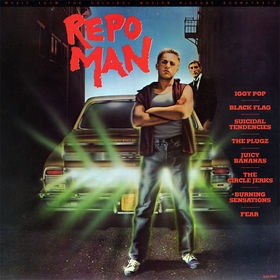
“Repo Man.” Alex Cox's cult film,
in a lot of circles, is almost better regarded for its soundtrack
than the film itself. (Though don't get me wrong, the film is great.
How could anything with Harry Dean Stanton, Fox Harris and Zander
Schloss be bad?) Staring off with the mean title track by Iggy Pop,
the rest of the album is a like a paen to early 80's West Coast punk,
including such titans as The Circle Jerks, The Plugz (God love Tito
Larriva!), Black Flag, Suicidal Tendencies and Fear.
Speaking of punk rock soundtracks, I
would be remiss to not mention either “Return of the Living Dead”
or “The Great Rock and Roll Swindle.” The former was actually my
early introduction to bands like The Cramps and The Flesheaters. That
alone is terrific, but it also features the indomitable The Damned,
45 Grave and an early incarnation of synth-outfit SSQ, which later on
morphed into the solo career of Stacey Swain aka Stacey Q. It's a
great soundtrack for one of the most fun and well-made non-Romero
zombie films.
“The Great Rock & Roll Swindle,”
a film whose origins begin with being the aborted Russ Meyer project
“Who Killed Bambi?” ended up being one fascinating mess of a
music film. There are moments of greatness within the film, with some
of the the highlights being Steve Jones romping in a neon bed with a
half-naked lovely in gold undies to “Lonely Boy,” only to have
coitus interruptus via a talking dog (!), the tribal-disco fusion
band, The Black Arabs, doing a “Stars on 45” type medley of the
Pistols hits and, of course, Sid Vicious beautifully butchering the
old standard “My Way.” The latter has become particularly iconic
and a great example of how one can really deconstruct something old,
hence making it new. Especially when it is the musical equivalent of
using a ball peen hammer and some crazy glue. Which is never, ever a
bad thing!
Of course, Tenpole Tudor's "Who Killed Bambi?" does have a huge place in my heart.
One of the most striking soundtracks to
have emerged in the last thirty years is absolutely Mitchell Froom's
work for Stephen Sayadian's post-nuclear masterpiece, “Cafe Flesh.”
Released as “The Key of Cool,” Froom's score, much like the
images and story it is accompanying, are not easily forgotten. It's
jazzy, infernal and is in dire need of being back in print. One of my
dreams is for not only “Key of Cool” to get a nice, new
re-release, but for “Cafe Flesh” itself to get the loving, uncut
and remastered treatment it so desperately deserves.
The soundtrack for Richard Elfman's
“Forbidden Zone” was an absolute staple of my latter high school
years. While I loathed high school, this film and soundtrack both
were one of the balms that got me through. At the time, I had only
seen the film once, renting a severely out-of-print copy from the
long defunct Hauser Video, but it was love at first site and sound.
It is a great insect-in-the-amber document of the Mystic Knights of
the Oingo Boingo, right before they became less Cab Calloway and more
New Wave as Oingo Boingo. Anyone who loves black & white film,
expressionism, old music, nudity, dancing frogs, Susan Tyrell, Herve
Villechaize, the Kipper Kids, my beloved Joe Spinell and Danny Elfman
dressed up as ole scratch himself the way that I do, must pick this
up.
Absolutely one of the most underrated
films and soundtracks ever has to be Bob Rafelson's “Head.”
Better known as the one film the Monkees ever did, “Head” is one
of the most exquisitely edited, subversive, dark humored rock films
ever. It initially flopped, with one of the biggest factors being
their fans expecting something just like the TV show: cute, zany and
fairly safe. Instead, they got the ole “the money's in, we're made
of tin” soft shoe, Vietnam war footage and Timothy Carey at his
most intense and out-of-bounds. (Okay, what am I saying? Carey was
always that magnificent!) The music matches the proceedings inch by
inch, with the absolute highlight being the haunting “The Porpoise Song.”
Some honorable mentions that I will
write about at a later date include:
“Shock Treatment”
“Urgh! A Music War”
“Christiane F.”
“Bram Stoker's Dracula” (Not
counting the Annie Lenox song. The score itself is gorgeous and much
better than Coppola's muddled effort.)
Anything Italian between the late 50's
and mid 80's
Anything with the names Les Baxter or
Angelo Badalamenti attached.
There's obviously way more, but
consider this piece to be a little bit of a taste of the proper. Now
as a bonus, here are two of my favorite songs from a movie.
The first is Mort Garson's theme from
Larry Hagman's “Son of Blob.” I have no idea how the film is, but
I do know that this song is a little slice of esoteric heaven to my
ears. I never need happy pills as long as I have access to this
delight. Also, Mort Garson was a genius whose library is itching to
be rediscovered.
The second is from the original “In
the Heat of the Night.” Featuring the uber-fantastic Anthony James,
“Owl on the Prowl” is like a hillbilly version of Sam the Sham's
“Little Red Riding Hood.” In other words, awesome. (Also, this is
for a friend of mine, whose taste surpasses even my own.)
The last time I was here, the weather was only halfway inhospitable and I had yet to be fully aware of the genius that is Mort Garson. After a long spell of three-digit weather and The Wozard of Iz, I am back with a small slew of updates and previews.
For you fans of all things "Dark Shadows" and Stanley Kubrick's THE KILLING, please check out the newest Video Watchdog. Issue 169 features a fantastic roundtable revolving around the groundbreaking Gothic soap opera, "Dark Shadows." The discussion includes such highly respected writers as Tim Lucas, Maitland McDonaugh, Richard Harland Smith, Kim Newman, as well as filmmaker Robert Tinnell and Dark Shadows historian, Darren Gross. Oh yes and I was lucky enough to be included to.
In addition that genre finery, you can also check out my review of one of my favorite films of all time, Stanley Kubrick's 1950's noir, THE KILLING. A film so great that it not only features such amazing actors as Marie Windsor and Elisha Cook Jr, but also the two titans of my film loving heart, Sterling Hayden and the man himself, Timothy Carey.
There will be more article goodness coming up for the great VHS loving zine Lunchmeat and of course, this very site as well. In fact, there will be something coming very soon that is wholly unique, so stay tuned kitty-cats.
Are you a fan of great film writing? How about Southern Exploitation, Cajun Style? Even better, the man himself, Timothy Agoglia Carey? Then stop whatever you are doing and pick up the newest issue of Video Watchdog! The power of Timothy Carey dancing compels you!
Greetings and salutations, my beloved and neglected readers and fellow fringe culture enthusiasts!
It's been much too long since the last post, but never fear, there are some big articles and little indulgences, all itching to be cooked and served. This includes more film and music articles, interviews and other random sundries.
To keep you a little sated until then, here's the trailer for the wonderfully goony BIKINI BEACH. Ever notice how much these films bordered on sun-drenched DaDa? While BEACH BLANKET BINGO is the masterpiece of this subgenre, BIKINI BEACH is a lot of fun, featuring tall drink of water Jody McCrea as Deadhead, Stevie Wonder, a surfing gorilla, Frankie Avalon in frightening limey drag as "The Potato Bug" and the first appearance of the ultimate Mondo Heather heart throb Timothy Carey as South Dakota Slim. It looks like a winner because it IS a winner!
“Live longer, Live Healthier, and let thy arse make wind! A Video Round-up and Tribute to Timothy Carey”
By Heather Drain
“We slip, we bleed. The truth is, I never really cared about conventional success. I was probably fired more than any other actor in Hollywood.” –Timothy Carey
Very few people have it and most of us do not. It’s the division between the Greek Gods and the mere mortals who are left to the farm, goats and vomitoriums. No, I’m not talking about religion or goat farming, but that tiny handful of artists who are so brilliant that they leave the rest of us in their dust. Years after they are gone into the ether of the afterlife, we are the ones eternally trying to catch up to them. Salvador Dali was one of them, as is Alejandro Jodorwosky, Clu Gulager, Bukowski and most definitely, Timothy Agoglia Carey.
On paper, Carey was a memorable character actor who worked with the likes of Stanley Kubrick (Paths of Glory, The Killing) and John Cassevettes (Minnie & Moskowitz, Killing of a Chinese Bookie). He also had a sizable body of work, often popping up on shows ranging from Gunsmoke to Mannix. The reality is that but so much more. Carey was a maverick of the biggest order and an artist who, like Sinatra, Elvis and Sid Vicious, did it his way. An artist and a man with true huevos who never took the easy way out on anything. This is the fabric, ladies and gents, of someone who will always be my hero.
Carey, as both an actor and director, possessed that incredible, rare human kinesis where you cannot take your eyes off of him for one second. There could be chimpanzees on fire while circus clowns openly weep, but if Carey is anywhere in the shot, he is the man you’re going to be looking at. Physically alone, he stood out. Most screen actors are pretty much on the wee side but not Carey, who was an oak of a man and stood around 6’5. Top that with jet black hair that often transformed itself into a pomp gone to seed (For the perfect example of this, see The World’s Greatest Sinner) and a pair of piercing, light blue eyes and you had a man whose looks alone commanded your attention.
But looks are like icing and are not substantial if you don’t have something underneath it for balance. Carey had that “it” factor, that presence that no amount of training, experience or plastic surgery can give you. It’s like being cool. You’ve either got it or you don’t. Give him a two-minute role in an hour and a half movie and trust that the main thing you will be talking about afterwards will be that guy. There have been and still are some great actors, but a tiny few can even come close to matching Carey’s intensity and sheer brilliance.
Unfortunately, the price one pays often for being ahead of their time is being majorly misunderstood by their peers, bosses and society at large. Eccentric at best and heaven help you if are not wealthy or charming enough to be given that moniker. Artists are communicators and have to fight, sometimes literally, to get their work out there and seen. Not everyone has to love it and in fact, sometimes they will utterly despise it, but if you are able to move their blank-eyed stares into some sort of emotion, then you have success. But people often loathe what they do not understand. Sometimes this is the fault of the filmmaker, but in this instance it’s more of a case of the man being ahead of the game by leaps and bounds.
Judging by his sole completed effort, the life changing The World’s Greatest Sinner and the glimpses of the works in eternal stasis, especially Tweet’s Ladies of Pasadena, Carey’s approach to filmmaking was unlike any others. The biggest fight for any artist, other than the communication breakdown, is being able to have a unique thumbprint. Especially when you realize cinema is often a daisy chain of inspiration. And while I’m sure Carey had his own inspirations, by the time he got behind the camera, every bit of it has his DNA in it a 110%. You can’t even fully compare it to the underground cinema of the time. If anything, Carey influenced a lot of those guys, not the other way around. This film is its own animal, all the way.
Being a real dyed in the wool maverick, Carey was bound to irk some people. There are near legendary stories of Carey pissing off actors ranging from Kirk Douglas, whom starred along side him in Kubrick’s war film Paths of Glory to Seymour Cassell. Why? Because he was some ego driven male diva? No because he tended to overshadow everyone on the screen. This was something never intentional and in fact, part of his drive as an actor was to heighten the quality of whatever project he was working on. It was this lack of ego that makes Carey all the more of a rare creature, especially with actors.
But if Timothy Carey was dynamite as an actor, then he was one neutron bomb of a director. His best-known work and only completed one is the one-of-a-kind religious rock and roller surrealist masterpiece, The World’s Greatest Sinner. The filming reportedly started as early as 1958, wrapped up in ’61 and was debuted in 1962. Watching this movie now is an intense experience but it must have felt like Stravinsky’s riot inducing performance of The Rites of Spring at its debut. This tale of a seemingly normal middle class salesman who turns into rock & roll playing evangelist who changes his name from Clarence to God Hilliard. God’s bad deeds include committing adultery with both an elderly woman and a teenage girl, then becoming completely disenfranchised with his family. The religious imagery is a real standout as well, with the most startling being God challenging the real thing by piercing a Eucharist that ends up bleeding.
This is some heady stuff. Showing something like this now to the unsuspecting spuds could elicit a charged reaction, but back in the early 60’s? Holy shit! Between the smart observations of both the weakness and power of one power-fueled man and an absolutely searing musical performance with a gold suited Carey gyrating to hordes of screaming fans, this is a movie that will brand itself on your psyche for a long, long time. It’s a revolutionary piece of work, then and certainly now.
It’s important to also keep in mind that this is an era where Elvis was censored from the waist down and guys like Pat Boone were raping the catalogs of good rock and roll records to make them less threatening to “proper” white families. A lot of kids today will see someone like the King and wonder what all the fuss is about. But I think anyone seeing Carey’s gyrations and instantly see the almost anihilistic lack of inhibition and fire that is going on in that man. You know, church never moved me that much but World’s Greatest Sinner? You better believe it!
Brothers and sisters, Mr. Timothy Carey was ahead of his time. Too ahead of his time as it turns out, since the film was very poorly received. Even its composer, a young Frank Zappa, famously ripped on it on the The Steve Allen Show. As ubersmart and gifted as Zappa was, he should have known better. This is the man that was responsible for films like 200 Motels , for crying out loud. (For the record, I am actually a Zappa fan and love his music for TWGS.) Carey actually stated on an episode of the West Coast public access show Art Fein’s Poker Party, that the only person that liked TWGS was the equally legendary John Cassevettes. Which is a shame and far from the truth now. At least Cassevettes put his money where his mouth was, since he cast Carey in both Minnie & Moskowitz and the great Killing of a Chinese Bookie. But more importantly, he also gave Carey film and editing equipment, along with trying to help him snag cast, crew and backers. It’s a tragedy that someone as special as Carey had to go through his life often misunderstood by so many.
That said, this is no sob story and someone like Carey deserves something better than trite pathos. His warpath of creative brilliance continued with a string of unfinished projects, starting with Tweet’s Ladies of Pasadena. No amount of description will prepare your eyes for this corneal cornucopia. The basic plot has Carey as the titular Tweet Twig, the only male in a knitting club called “Don’t Drop a Stitch.” He’s surrounded by knitting old ladies, a blowsy weightlifting cockney blonde for a wife (whom at one point bellows “Oh no! More bloomin’ animals!”) and a horde of the aforementioned animals whose nakedness will be clothed by Tweet and his ladies’ creations. If anything will ever make you want to flash your collective asses to network television as a whole, it is knowing that this was turned down. Yes, this was a TV pilot and in my Utopia, this is what would be on TV 24/7. Forget Lost, I’d much rather see Timothy Carey as this lovable bumble Tweet knitting and dressed up as a Native American Indian for no discernable reason. Do not fear Dada, folks.
Another project was A.L. and before you start having images of Franken or Capone drift in your heads, it is LA backwards. Quite fitting given that the plot revolved around a young midwestern couple that gets lost on the Los Angeles freeway while the wife goes into labor. Along the way he runs into your average person wandering the streets of LA; the worker, the illegal immigrant, the bums, the street kids, etc. Undoubtedly, it would have been great especially given that everything happens in one day. This was one of the big projects that Cassevettes tried to get backed for Carey, but was kyboshed when studio execs would only accept it if a lot of changes were made. This was unacceptable for an artist like Carey and the film was never made.
His last big project was a play/film entitled The Insect Trainer, in which he played the lead character, restaurant dishwasher Guasti Q. Guasti ends up being on trial for murder after letting out a ballast of flatulence so strong that it physically knocks over an old woman. Her fall proves to be fatal and at some point, Guasti realizes he has a talent for training insects. The Insect Trainer was inspired by the twin figures of Salvador Dali and Le Petomane, the famous French Fartiste. Footage of this film exists and is certainly very, very high on my personal wish list. Apparently Martin Scorsese donated $3,000 to the production, which just highlights the fact that Scorsese is the real deal. (Taxi Driver alone has forever and always sealed my love for the man. No matter how many times he uses Leonardo Dicaprio in his films.)
Timothy Carey was taken away from this plane on May 11, 1994 after suffering a massive stroke. Our bodies will always ultimately fail us in the end but it is the marks that we leave here that can be the testament of the spirit. Timothy Carey’s legacy is huge, as actor, writer, director and man. He was that rare force of nature whose power and beauty will never be equaled and always admired by anyone smart enough to be open to it.
Now onward ho to the audio/video celebration of this supernova of one man’s vision, talent and spirit. Always remember those that you may write off, so called madmen are sometimes the most perceptive of us all. (Except for that guy in your front yard wearing a ski cap on his genitals and singing “Oh Susanna.” He’s just batshit crazy.)
Anyways, on to the Video Round Up!
Ah yes, the infamous dance from the 1957 drive-in cult classic "Bayou" aka "Poor White Trash." It starts out as cute but as soon as Carey enters the scene, you know you are witnessing something really special. Note the way he grabs on to leading lady Lita Milan's hair, even deftly switching hands when he takes his shirt off. Wow!
One of my favorite moments in "World's Greatest Sinner." This is one of the most truly rock and roll moments ever committed to celluloid. I would love to watch this scene back to back to the Cramps doing "Tear it Up" from "Urgh! A Music War."
This is like having your psyche hugged by an angel. Enjoy!
Carey as "Moose" on the 70's chestnut, "Mannix." Nuff said!
INCREDIBLE clip of Carey on Art Fein's show. Bless this man for sharing such a rare gem with us. Notice the reference to Carey's scene stealing turn in "Beach Blanket Bingo!" And yes, the farting.
Carey's hilarious and demented turn in the Monkees' cult classic "Head." Attaboy Mike!
Here are some very fascinating links to interviews and articles dealing with the man.