Showing posts with label Stephen Sayadian. Show all posts

Sunday, September 14, 2014

Post-Nuclear Expressionism: A Stephen Sayadian Sampler

Still from "Red White Acrylic Dream"
Imagine a time where filmmakers were shadowy figures of mystique, only mentioned at awards shows and, if they were really unlucky, clucked about in rags written by harpies like Louella Parsons and Hedda Hopper. (And boy, if ever a name was built for literally harpy-ing, it was Hedda Hopper, but I digress.) In this day and age of social media and artists tweeting the exact specs of their brunch at Barney's, it is rare to see a living filmmaker still shrouded in mystery and falsehoods bordering on urban legend, but yet, all of this and more applies to Stephen Sayadian.

Album cover for Wall of Voodoo's "Happy Planet." Note the fish, a motif that appears again and again in Sayadian's work.

For the unfamiliar and unconverted, Sayadian is a former ad-man and current filmmaker and artist whose best known works include the post-apocalyptic, science-fiction adult film, “Cafe Flesh,” as well as the neon-expressionist sequel-in-spirit to the German silent film classic “Cabinet of Dr.Caligari,” “Dr. Caligari.” But his resume is much more than that. In addition to working with Francis Delia on the classic “Nightdreams,” in which Sayadian himself appeared in one of the most joy-happy moments in cinematic history as a dancing piece of toast, (In wingtips, no less!) Sayadian got his big start working as the advertising art director of Hustler Magazine, though the masthead often lists him as assistant art director. He made his official debut in the December '76 issue, with the article “Hustler's Sleazy Shopping Guide.” Starting off with a sense of humor that at times played out like Mad Magazine meets Grand Guignol, it wasn't long before Sayadian's distinctive visual eye and wholly unique thumbprint would come into full play at the magazine. 

From the January 1977 issue.
One of the most amazing things about seeing Sayadian's work in Hustler is realizing how young he was. Born on October 18th, 1953 in Chicago, Illinois, Stephen was all but 23 years old when he started at Hustler. Coming from a commercial background that included writing the fortunes that were included in the individual pieces of Bazooka Joe gum, he truly was the Madison Avenue Wunderkind when he was brought into the fold at Hustler. Sayadian left the magazine for awhile in late '78, right after the assassination attempt on founder and editor Larry Flynt. But as Larry healed up and became more involved directly with the magazine again, Sayadian returned and created some of the best and most memorable layouts in Hustler's history. This included “Red, White Acrylic Dream” in the July 1984 issue, which famously invoked such American advertising brand stalwarts as Bob's Big Boy, the Morton Salt girl and Aunt Jemima, coupled with text by frequent Sayadian collaborator, Jerry Stahl. It takes the “erotic nightmare” aesthetic that was used so beautifully in his films and in turn, he created something simultaneously poetic and ghoulish about our own culture. So much of modern American pop culture is completely riddled with advertising and commercial tactics, which is one of many layers in Sayadian's creative keenness. 

Cover for the "Thing Fish" spread in Hustler
 Another hallmark layout was the collaborative piece with Frank Zappa for “Thing Fish” in the April 1984 issue. Based on Zappa's three-LP album of the same name, the spread featured model/comedienne Annie Ample, spaghetti used as a lewd metaphor, a giant reproduction of the infamous Pat Boone exposing his penis photo and, of course, the titular “Thing Fish.” (The latter was voiced by Zappa-regular Ike Willis on the album, but here is portrayed by a glorious creature designed by Jene Omens.) Frequent Sayadian collaborator, intensely skilled Austrian photographer Ladi von Jansky, lensed this spread, as well as the cover for the actual album. (Ironically, it is von Jansky's birth date and homeland that are often erroneously listed as Sayadian's, despite them being very much two separate individuals. In fact, von Jansky went to school with Milos Foreman and was, in his youth, the Austrian equivalent to James Dean.) 

Two geniuses: Sayadian & Zappa. Photo by Ladi von Jansky.
In addition to his print work, he also worked on a number of music videos, including both Wall of Voodoo's pioneering “Mexican Radio” with Francis Delia, as well as the latter-day incarnation of the band and their cover of The Beach Boys “Do it Again.” (Complete with Brian Wilson cameo and a Keene-faced beach bunny.) But it is his film work that has made the deepest and most seismic-type impact. In a world of remakes, personas, reboots and pretensions, there is no filmmaker, living, dead or demon that is like Stephen Sayadian. His fingerprint is unmistakably his and while Sayadian has influenced numerous artists since making his debut with “Nightdreams,” no one has ever come close to touching him.


While he has flown under the radar for the past several years, Sayadian himself has been surfacing more and more, between an appearance at last year's L'Etrange Festival in Paris and showing up for one barnstormer of a Q&A session with Stahl at the Cinefamily Event showing “Cafe Flesh” in Los Angeles. Could it be a sign of fresh and bigger things afoot? Absolutely, with a new film entitled “May's Renewal” in the works, which for the handful that have read it indicated that all signs point to it the being the best and most transformative Sayadian film yet. If 2014 has been the year of Jodorowsky's return, then 2015 will be the year of Stephen Sayadian.


Thanks to David Arrate for the Red, White Acrylic Dreams scans and super-special thanks to Stephen Sayadian for everything. 

© Heather Drain 2014

Monday, February 3, 2014

Mondo Roundup: Going to the Theater Edition


There is something achingly beautiful and yet flat out achy when it comes to decayed movie theaters. Once upon a time, not that long ago in fact, going to the movies was an epic and occasionally glamorous thing. Even when I was a little girl in the 80's, with the glory days of the palatial, gilded frame movie houses being long, long gone, the theater was still a magical place. Sure, the movie theater in question was realistically a ratty dollar theater attached to a strip mall, probably built in the early to mid 70's, but for a kid, it was the closest thing I had to a living remnant to an era of film that I only knew via large film books with yellowy pages.

Of course, it helps that this was right before the stinky hand of commercials had infiltrated the movie going experience and even at a pee-stenched theater whose glory days were dubious from inception, the stained red curtains parted like the red seas when the trailers began. It's a seemingly small gesture but it was all part of the dingy majesty for me. 


The small town I grew up in actually did have a proper, non strip-mall attached theater too. The Apollo Theater, nestled in the historic and semi-neglected as long as I can remember historic downtown area, was always there. Doing research, they were showing kids films when I was a toddler and before then, adult films. Before that? I'm not sure, but what I do know is that it is still there. All but practically condemned and rotting from the inside, the Apollo now has all the appearance of waiting to die. Which is a shame. Beyond a shame but the structure, still there after decades of growth and Appleby's, gives a faint shadow of hope that maybe someone will rescue it. Just because something is neglected, doesn't necessarily mean it has to die. 


The other night, as I was trying to work on the above passage, I got sucked into one of the most recent episodes of The Rialto Report and their fantastic interview with Veronica Vera. There was something about this particular interview that, by the end, hit me emotionally. Here's this amazing woman, who is so classy, smart and someone who has made an incredible thumbprint in this world by being so open to new frontiers, both in terms of sexuality, as well as writing and gender. We live in a culture where the accepted image of someone being open and outside the status quo fray is “Dharma & Greg” or whatever “manic-pixie” mainstream dream machine you want to invoke. Accepted risks are buying a faux African-patterned skirt from a store at the mall. But Vera, along with many of her peers and the subjects of Rialto's other interviews, took real risks.

It's incredibly weird to me that it is 2014, a number so Jetson-sounding in its futurism, that things like “slut shaming” and overall stunted attitudes towards human expression involving sexuality are still alive and well. Kind of like that small militant army of cockroaches that live underneath your kitchen sink, outdated morals refuse to die in our culture. And that's part of why I do what I do. Outdated mores tend to blind people to art. A chaste female nude is considered auto-art by some, but yet the moment that nude gets to derive pleasure from something more than just the male gaze, it's smut and therefore, not deemed respectable or worth examining. This is beyond ridiculous. Attitudes like this should be relegated to the same kind of snickering we save for things like medicinal leeches and the belief that the devil is tied to mental illness.

With our culture, it's not just simply about out-moded puritanism but classism too. It eternally mystifies me that guys like Gerard Damiano, Cecil Howard or Stephen Sayadian are all but labeled pornographers but their European/Asian counterparts like Oshima, Breillat and most recently, “Nymphomaniac” director Lars von Trier are deemed artists. And you know what? They ARE artists but so are Damiano, Howard and Sayadian. But the key difference between the latter three and the former is that the latter are not only American, but worked in a milieu that is considered to be the bottom rung of the bread and circuses ladder. The more lower-class a medium is perceived, the more derided, if not flat out neglected, it is. Which is strange. Shouldn't this be the enlightened age? It's okay to have a film display raw human sad emotion but sexuality is still taboo? 

 
Now, speaking of the tawdry, you can check out my latest for Dangerous Minds, covering the ultra-obscure Russ Meyer film, “Fanny Hill..” It is tame for the master of bosmania but that said , still a lot of fun and looking better than it ever has, thanks to the hard work of the folks at VinegarSyndrome.

Saturday, September 21, 2013

Weekly Mondo Round-Up: The Bang Bang Edition


The past few weeks have been extremely exciting for fringe culture fans everywhere. For those in the know, the uber-fantastique film festival, L'Etrange just wrapped up, with one of its best line-ups ever. The festival included showings of Frank Henenlotter's incredible looking documentary “That's Sexploitation,” John Waters “Desperate Living” (my personal favorite of his), tributes to “Last Horror Film” star Caroline Munro  and even a showing of Erich von Stroheim's “Foolish Wives.” Of course, the granddaddy move was the focus on the work of Stephen Sayadian, with each film being presented by the man himself. Getting to see an artist I admire greatly get this kind of recognition is a huge joy. For the curious, there's also a good interview up on Twitch.

My only problem with a lot of the press, which has honestly been wonderful, is that I think we can officially kill the term “porn” when talking about an artist like Sayadian. If you're gonna call films like “Cafe Flesh” porn, then you better call “In the Realm of the Senses” and “Anatomy of Hell” porn too. Now, there's nothing inherently wrong with porn in and of itself. Not at all, but there is an ocean of difference between films like “Nightdreams” and say, “Anal Angels 9.” If guys like Sayadian or say, Gerard Damiano, were European and had bigger budgets, the porn term never would have been applied. It's a classist move, after all no one calls Egon Schiele a pornographer, even though he featured erotic themes in his artwork. To me, nudity and sexuality do not make automatically make something pornography.  


Speaking of thrilling artists, the news of Alejandro Jodorowsky's new film, “The Dance of Reality” has emerged, along with a trailer that looks like it is going to be yet another masterpiece from the man. The imagery already brings to mind both “Santa Sangre” and “Viva la Muerte,” which was helmed by Jodorowsky collaborator and fellow Panic movement founder Fernando Arrabal. 


Another new development, at least on my end, was a highly rewarding trip to the local used bookstore. After looking through the Art books for a minute, I immediately bee lined it to the film section. For a minute, it appeared be the usual one-two-three punch of dry academic journals on Truffaut and general movie review guides, but then I saw it. A hardback copy of “Sex in the Movies” by Jeremy Pascall and Clyde Jeavons, a book I have read about for years. In fact, it was recommended to me by one of the most brilliant film writers I have ever known, so I knew it was a must have. Now, if that felt like kismet, then what I found almost right next to it was like running into a dear old friend. Another hardbound book entitled “Cut! The Unseen Cinema” by Baxter Phillips. This book is very special to me since it was one that I studied from page to page as a young girl. Covertly, of course, since it is brimming with nudity and violence, as well as images of religious/political subversiveness. On one hand, I was probably way the hell too young to be reading it but on the other hand, I am grateful for the exposure. It was this book that planted some of the key seeds for my development as a film writer. Titles that are huge to me now are mentioned in that book, including Ken Russell's “The Devils” and Walerian Borowcyzk's “La Bete.” I haven't looked at “Cut!” since I was a kid, so finding it again feels like love. 

As for the film writing, if you haven't already, please check out some of the latest for Dangerous Minds. I got to explore the rare landscape of kung fu prurience with “Vixens of Kung Fu: Tale of Yin Yang,” which features an all star cast and some of the dodgiest martial arts this side of your Low Mein buffet. On top of that, I also write about the Mondo occult relic, “Witchcraft '70," which is goony in a swanky-devil-scare sort of way. 

Hope everyone reading this is having a wonderful and safe weekend. Fall's almost here and what better way to celebrate it than watching Iggy Pop on German TV lip syncing around a bunch of confused looking models? Enjoy!


You can also find me on Twitter, Tumblr, Pinterest and Google+.


Tuesday, September 10, 2013

Weekly Mondo Round-Up: The Movie Music Edition


One of the absolute biggest rewards about writing are those rare and wonderful lucky moments when something you have written ends up moving another writer. I was blessed enough to have this very thing happen recently with the last Weekly Mondo Round-up, with my friend and fellow film writer, Goregirl's Dungeon, when she wrote a fabulous post about the independent music scene in Vancouver in the late 70's and early-mid 1980's. If you have not read her site before, please check it out. It's full of fun, quality film writing and you may just learn something.

Speaking of music, one of those dreaded yet masochisticly compelling Rolling Stone lists popped up the other day, this time covering the top 25 soundtracks of all time. In fairness, it wasn't as heinous as I was expecting, but there were some glaring omissions, to say the least. Music and film are like peanut butter and chocolate. The combination, when done well, is luscious and kinetic.

Since part of the reason I write in the first place is some strange moral compulsion to right the cultural wrongs of the world, I figured I would contribute my own personal list of superb soundtracks. The key difference with this list, other than being naturally quality, is that I refuse to put anything in numeric order. How art hits you can be really mercurial, all depending on your mood, the position of the moon, how the postman looked at you, etc etc. So with all of that in mind, here's just a taste of some of my favorite movie music!


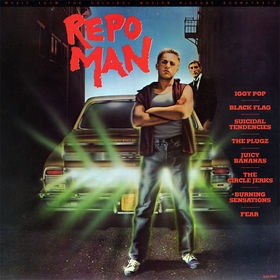
“Repo Man.” Alex Cox's cult film, in a lot of circles, is almost better regarded for its soundtrack than the film itself. (Though don't get me wrong, the film is great. How could anything with Harry Dean Stanton, Fox Harris and Zander Schloss be bad?) Staring off with the mean title track by Iggy Pop, the rest of the album is a like a paen to early 80's West Coast punk, including such titans as The Circle Jerks, The Plugz (God love Tito Larriva!), Black Flag, Suicidal Tendencies and Fear.


Speaking of punk rock soundtracks, I would be remiss to not mention either “Return of the Living Dead” or “The Great Rock and Roll Swindle.” The former was actually my early introduction to bands like The Cramps and The Flesheaters. That alone is terrific, but it also features the indomitable The Damned, 45 Grave and an early incarnation of synth-outfit SSQ, which later on morphed into the solo career of Stacey Swain aka Stacey Q. It's a great soundtrack for one of the most fun and well-made non-Romero zombie films.


“The Great Rock & Roll Swindle,” a film whose origins begin with being the aborted Russ Meyer project “Who Killed Bambi?” ended up being one fascinating mess of a music film. There are moments of greatness within the film, with some of the the highlights being Steve Jones romping in a neon bed with a half-naked lovely in gold undies to “Lonely Boy,” only to have coitus interruptus via a talking dog (!), the tribal-disco fusion band, The Black Arabs, doing a “Stars on 45” type medley of the Pistols hits and, of course, Sid Vicious beautifully butchering the old standard “My Way.” The latter has become particularly iconic and a great example of how one can really deconstruct something old, hence making it new. Especially when it is the musical equivalent of using a ball peen hammer and some crazy glue. Which is never, ever a bad thing!


Of course, Tenpole Tudor's "Who Killed Bambi?" does have a huge place in my heart.


One of the most striking soundtracks to have emerged in the last thirty years is absolutely Mitchell Froom's work for Stephen Sayadian's post-nuclear masterpiece, “Cafe Flesh.” Released as “The Key of Cool,” Froom's score, much like the images and story it is accompanying, are not easily forgotten. It's jazzy, infernal and is in dire need of being back in print. One of my dreams is for not only “Key of Cool” to get a nice, new re-release, but for “Cafe Flesh” itself to get the loving, uncut and remastered treatment it so desperately deserves.


The soundtrack for Richard Elfman's “Forbidden Zone” was an absolute staple of my latter high school years. While I loathed high school, this film and soundtrack both were one of the balms that got me through. At the time, I had only seen the film once, renting a severely out-of-print copy from the long defunct Hauser Video, but it was love at first site and sound. It is a great insect-in-the-amber document of the Mystic Knights of the Oingo Boingo, right before they became less Cab Calloway and more New Wave as Oingo Boingo. Anyone who loves black & white film, expressionism, old music, nudity, dancing frogs, Susan Tyrell, Herve Villechaize, the Kipper Kids, my beloved Joe Spinell and Danny Elfman dressed up as ole scratch himself the way that I do, must pick this up.


Absolutely one of the most underrated films and soundtracks ever has to be Bob Rafelson's “Head.” Better known as the one film the Monkees ever did, “Head” is one of the most exquisitely edited, subversive, dark humored rock films ever. It initially flopped, with one of the biggest factors being their fans expecting something just like the TV show: cute, zany and fairly safe. Instead, they got the ole “the money's in, we're made of tin” soft shoe, Vietnam war footage and Timothy Carey at his most intense and out-of-bounds. (Okay, what am I saying? Carey was always that magnificent!) The music matches the proceedings inch by inch, with the absolute highlight being the haunting “The Porpoise Song.”

Some honorable mentions that I will write about at a later date include:

“Shock Treatment”
“Urgh! A Music War”
“Christiane F.”
“Bram Stoker's Dracula” (Not counting the Annie Lenox song. The score itself is gorgeous and much better than Coppola's muddled effort.)
Anything Italian between the late 50's and mid 80's
Anything with the names Les Baxter or Angelo Badalamenti attached.

There's obviously way more, but consider this piece to be a little bit of a taste of the proper. Now as a bonus, here are two of my favorite songs from a movie. 

The first is Mort Garson's theme from Larry Hagman's “Son of Blob.” I have no idea how the film is, but I do know that this song is a little slice of esoteric heaven to my ears. I never need happy pills as long as I have access to this delight. Also, Mort Garson was a genius whose library is itching to be rediscovered.


The second is from the original “In the Heat of the Night.” Featuring the uber-fantastic Anthony James, “Owl on the Prowl” is like a hillbilly version of Sam the Sham's “Little Red Riding Hood.” In other words, awesome. (Also, this is for a friend of mine, whose taste surpasses even my own.)


You can also find me on Twitter, Tumblr, Pinterest & Google+.


Friday, July 5, 2013

Weekly Mondo Round-Up: The Firecracker Edition


 It's post-Fourth of July here in the States but you would not know that around my neighborhood. Lots of noise, smoke and glitter. No mangled bodyparts just yet, but the evening is still young. Earlier today, after stumbling upon a small Farmer's market in a nearby berg, I was reminded of the last time we visited such a thing. There was a local group of hipster-y, psuedo-folk-jug fellows playing, all covers of course. Nothing inherently wrong with that, especially since covers are the groundwork a lot of bands use to build their chops, but I realized that if you're the kind of group that can instantly play “Me & Julio Down By the Schoolyard” or whatever that hideous Paul Simon song is, then I instantly never want to hear you again. Imagine hearing someone covering some Coltrane, Les Baxter or Killing Joke? Now, that would be sweet. But good lord, no Paul Simon or any other pap that makes middle-upper class middle-aged white people feel comfortable. The ultimate credo of any artist should never ever be “give the people what they want.” Nay, give them what they deserve. That? Is true love. 


 On a far happier and rewarding note, the latest issue of Paracinema is now available for pre-order. In addition to featuring articles covering everything from the great David Patrick Kelly to action film heroes, it will also have my compare/contrasting article on Stephen Sayadian's two equally brilliant films, “Nightdreams” and “Dr. Caligari.” If you haven't seen these films, then do yourself a favor and seek them out immediately. Sayadian is one of the most standout directors to have emerged in the last thirty years, so it was a pleasure getting to explore these two semi-twin works. For the converted and uninitiated alike, you can check out my friend David Arrate's tribute on his Tumblr, My Kind of Story or view the clip below. If these things don't convince you, especially the dancing toast, then you've got ice in your veins, baby. 


One album that has been getting a lot of play this week in Casa Mondo has been Fallen Angels. This is a band that is ripe for some proper rediscovery. Led by Knox, who also founded the legendary punk group The Vibrators, and featuring the entire rhythm section of Hanoi Rocks (Razzle, Sami Yaffa and Nasty Suicide), Fallen Angels were a terrific, trash-rock band that managed to incorporate some emotional gravitas sans the usual gouda baked overdramatics. From the same family tree that begat the New York Dolls, Johnny Thunders & the Heartbreakers, Hanoi Rocks (naturally) and Lords of the New Church, Fallen Angels, especially that killer first album, deserves to be placed next to its more well known brethren. 


Currently working on contributions for both Rupert Pupkin Speaks and the upcoming, William CastleBlog-A-Thon, as well as the usual article work. Wonderful things are afoot.


You can also find me on Twitter, Tumblr, Pinterest & Google+.


Friday, March 9, 2012

Shadow Worlds of Cinema: An Interview with Susie Bright


Every art movement worth its salt is going to have its share of detractors and controversies. Chances are if a work of art has caused at least one parent's group ire, then it is something worth checking out. (And if it's caused a riot, then it is a masterpiece. But that's for another article.) The best kind to stoke the fires of status quo morality is often “lowbrow” art. Whether it is horror comics, pulp novels, heavy metal music or fringe cinema, these are often the works that are critically panned, if paid attention to at all, they repulse the ethically insecure and when they're really good, give the social rebel hope.

One of the writers that has been an essential part of these needed fringe worlds of art is the one and only Susie Bright. A name that should already be familiar to most that will read this article, she has been a keen figure in the world of feminism, zines, erotica and LGBT rights. Something that not everyone reading this might know, though, is that she has written a number of great film articles and reviews. It feels like that the cult film world has not given this woman enough credit and that day is changing now, especially with her recent book, SusieBright's Erotic Screen: The Golden Hardcore & The ShimmeringDyke-Core. This e-book is indeed shimmering, making it a must read for anyone who has a deep love or at least, a curiosity, about a time period when cinematic erotica had a number of ambitious artists and filmmakers involved.

If you are looking for something prurient, go elsewhere, since this feast is more focused on great writing, cinematic history and peeking into cultural corners. I loved this, since it fed my inner Murray Head. (“I get my kicks above the waistline, sunshine.”) 

Ms. Bright was extremely kind enough to agree to answer a few questions, via e-mail. Enjoy!

First of all, I love the quote on your blog from Rolling Stone, “Could not be accused of shutting up.” A magazine that toothless should be grateful to have someone smart and with actual informed opinions talking! There is a fine art of the un-quiet, which shines in your book, “The Golden Hardcore & Shimmering Dyke-Core.” Being an open and honest writer, did you ever feel any resistance from editors and/or publishers?

Oh, all the time; but I consider that a healthy tension— to a certain degree. If someone fawns all over you, there’s probably something amiss.

But you are probably asking something more difficult, which is, “Have I ever been discriminated against?”

Yes, all the time. The prejudices are well known.

I rarely hear the blunt rejection to my face-- it’s usually told second-hand, or in hoary euphemisms. I remember one editor got very drunk and called me in the middle of the night to weep and confess every awful prejudice that had been uttered against my work in their publishing chambers. Feminist, whore, queer, nigger-lover, communist, pervert, etc.
And that’s from the “liberals.”

I guess the main thing to say at this point is, “Who cares what ‘THEY’ say?” The old gatekeepers to the publishing empires are irrelevant today.

My latest book in point: No one in mainstream publishing would’ve bought the rights to “Erotic Screen”-- they can’t even wrap their minds around a topic like that, the golden age of porn and the origins of indie erotic film making.

But it doesn't matter. I know who my audience is; they’re eager for it, and I can self-publish and reach them myself. By the time it becomes “big news,” I will have established the beachhead. I already have. 

Honestly, nothing new ever happens waiting for the Big Boys to “discover” you sitting on a soda fountain stool. You have to come up with your own little revolution and then watch and see what happens!

 
-Also, what kind of reception did you initially get from other writers?

Oh, I’m in a longtime supportive community of working writers. People who’ve been supporting their families for decades with their writing are not prissy about anything. "If you’re working, good for you—" that's the attitude among the craft. There’s few writers that haven’t tackled sexual subjects at one time or another.

Jamie Gillis

-Classic era adult films are the living definition of fringe cinema and like all fringe cinema. A lot of it does not deserve to be put in the back room ghetto. Being an artist and being marginalized because of your own private milieu is incredibly unfair. How did a lot of the actors and directors that you knew in this field handle this critical prejudice?

Well, I think many of the names you know today, like Nina Hartley or Annie Sprinkle--- or the late John Leslie or Jamie Gillis— are household names because they have been outspoken and militant, in addition to prolific.

The people who are articulate, charismatic, dogged, lucky… they’re the minority. But you could say that about every actor working anywhere.

Most people in porn, like everyone else in the Hollywood colony, just drift in and out, rather unheralded, never becoming famous. It is a tough business where you often feel used and thrown out like yesterday’s dishwater, after a very brief period of time. I would say the same holds whether it was TV sitcoms or porn flicks.

People think porn is some nether world that has nothing to do with the rest of show business, but it’s quite the opposite.

 John Leslie

-Any post-Silent film worth its salt will have some sonic goodness and the classic films of this era are no different. (Directors such as Cecil Howard, the Dark Brothers and Stephen Sayadian are especially standout in this arena.) What are some of your favorite soundtracks of the adult era?

Oh, definitely Night Dreams. (Editor Note: Indeed! Any film that features Wall of Voodoo's “Ring of Fire” is something very, very special. Also, Mitchell Froom's excellent soundtrack for Rinse Dream/Stephen Sayadian's Cafe Flesh is worth checking out.)

 Speaking of Cafe Flesh....

-Were there any adult films that you were initially excited about, only to be disappointed with?

When a director is good and does something new, there’s so much pressure to pump up the volume, just churn stuff out. How many people can be Andy Warhol? I really can’t think of any!

Almost all my fave directors got burnt out at some point and did less than stellar work in their later years, unless they had refreshing break!

In that vein, what are some of the most overrated titles? (In my opinion, Debbie Does Dallas would be the ultimate. How titles like FIRESTORM and MEMORIES WITHIN MISS AGGIE are semi-obscure and that smut-for-mongoloids is famous is beyond me.)

Yeah, Debbie is one of those Texas cliches that is “all hat, no cowboy.” It’s all “title” and no film. Someone poured ten times the marketing budget into that film than they did on the actual production.

Actually, it presages the current porn vogue for jumping onto current events and trends, be it the Sarah Palin parody, Nailin' Palin, or Avatar. Debbie was an attempt to jump on the tremendous heat behind the Dallas Cowboys, the biggest thing in the sports world at the time.

Firestorm is one of Cecil Howard’s greats, and luckily, he kept all his rights, kept masters of all his films. Thank god. He and Radley Metzger were unique that way.

If someone made a porn film right this minute starring a Jeremy Lin lookalike, just imagine the pandemonium. I’d go see that!

As for Miss Aggie, that was Damiano’s third film, his followup to the excellent Devil in Miss Jones, and really when he felt like he was moving into mainstream theatrical film territory.

During those times, the money was accessible, and it was a HUGE production— all the stops pulled out. They thought that the Ratings Board and the puritanical rules regarding film were coming to pieces-- that sex and drama put together in professional creative manner was here to stay!

Well, unfortunately, they were wrong. The 70s were the biggest high water creative mark for American films since before the Hays Office meltdown.

And they were crushed. It wasn’t just porn, it was everything that brought indie cinema into fruition in the 70s: Scorsese, Cronenberg, Altman, Fonda, Hopper and the whole bit. Those famous names survived and adapted, but the revolutionary erotic spirit… not so much.

I see it opening up again only now, when technology has just ripped apart the old expectations again.

 The Man, Gerard Damiano.

-On a more positive note, did you encounter any films that you went into expecting the worst and walked out being pleasantly surprised?

Oh sure, all the time. I would say I was surprised by virtually every film I saw theatrically. When I saw video innovators like Chris Rage, and Rodney Werden, and the lesbian stuff my comrades were making, it was "goosebump time."


-One of the titles you have a lot of love for in the book is Smoker, which got a DVD release last year. Unfortunately, VCA, which is also responsible for the substandard DVD release of the sci-fi/art film classic Cafe Flesh, has excised over 20 minutes of footage.

Yes. It reminds me of all the silent films that were destroyed in the 20s. (Ed. Note: Not to mention a lot of the pre-Hays code talkies. See, CONVENTION CITY.) I'm writing about this for Volume 2 of The Erotic Screen.

 
In the days of the Meese Commission scare, it is halfway understandable, but in these days of the Whitman's sampler of lurid hell you can find on the net and in ones local video store legally, what is your theory of why many film companies are releasing these films censored and with battered prints to boot? Is it laziness or fear or just a complete lack of caring about their archive?

When Russell Hampshire, the owner of VCA (the biggest XXX video distributor at the time) got of of jail on obscenity charges following the Meese Commission bust, he told his lawyers, “I never want to go to jail again. EVER. Tell me what to do.”

His lawyer, Paul Cambria, wrote a memo

Followed to the letter, the advice from the memo would destroy most of their back catalog.

And they did.

There were voices who said, “But this is art! Someday the Criterion Collection is going to want this! Scholars will study it!”

But they were ignored with the same mandate.

This really is just like what happened in the Silent film days after the Justice Dept went after them.

The rest of the companies, besides VCA, hadn’t been forced to send anyone to jail. So they just decided to wing it and see if anything happened. Nothing did. They kept their catalog intact and only VCA destroyed theirs. Since VCA had so many classics, it was a holocaust.


-Working and writing about these films, did you ever receive any backlash from some of the more politically correct members of the feminist community?

Oh yes. See my memoir. Endless, endless, ad hominem attacks, multiple assassination attempts (no fooling), unrelenting smear campaigns. What a complete waste. What did the feminist movement get out of it? Look at the horrible state we’re in now, fighting for fucking birth control all over again.

-Every interview needs at least one fun and semi-cheesy question and this one is no exception. What is your classic era dream team? (Actors, actresses, directors, writers, composers, etc etc)

Oh gee! Well, Radley directing Sharon Mitchell, I’d like that. Jamie Gillis with Robert De Niro. Chris Rage making a Disney movie.

 The Private Afternoons of Pamela Mann


-The decline of the classic era is often attributed to the rise of video. However, filmmakers of all types have been able to use professional video equipment to make some unique and good movies. I've always felt that it is more supply and demand. If the public at large demanded better movies (of any genre), then the people with the pocketbooks would be forced to financially back more intelligent and creative efforts. However, that's just me being opinionated, so what are your feelings on this?

You’re right. You see that in gay movies, where there IS a more discriminating audience, and they get better movies.


-Where there any particular artists that you always wanted to meet and/or interview, but never did?

Damiano! Alex D’Renzy. And it’s weird that I washed Linda Lovelace’s car in high school, but never saw her again. When I was 15, I had no idea I’d be covering her career someday.

Andy Nichols in Cafe Flesh

-Any ongoing, new or vintage projects you would like to mention or promote?

I'll be publishing The Erotic Screen, Volume 2, at the end of this year. It will include such classics as "Stalag Porn," and "The G-Spot Fraud Detection Squad." If you'd like to be on the mailing list for its debut, mail me at susie@susiebright.com


I cannot thank Susie enough for taking the time out of her busy schedule to answer my questions. Feel free to check out her Amazon store for an assortment of her available works and of course, her website.